Learning design principles
Research-informed, tested through learner work.
Etuosity uses learning science as design guidance, then studies how learners explain, remember, create with, and transfer ideas after those ideas are connected to anchors and relationships.
The responsible frame
The science shapes the design. Learner work sharpens it.
The project draws from durable learning principles: organized knowledge supports retrieval and transfer, multimodal experience can support attention, emotional salience can mark importance, and active explanation can deepen understanding.
Etuosity treats those principles as a design engine. Experiences are built, observed, measured through learner output, and refined through review.
Current stage
The model is being developed through examples and review.
Etuosity is not claiming the model is finished. The project is developing examples and review loops with contributors so anchor-based learning can be inspected, tested, revised, and eventually shared as public materials.
The evidence-building phase looks at learner explanation, retention, transfer, educator review, adult learner cases, pilot feedback, and iteration notes.
Open examples
The examples make the design choices visible enough to review.
Transfer checks
The useful question is whether learners can use the idea in a new setting.
Principle one
Relationship before recall.
Many learners do not retrieve isolated facts reliably. They retrieve networks: the story around the idea, the emotional weight, the related people, the sensory context, the conflict, the image, the movement, the consequence, or the pattern.
Etuosity designs for those retrieval paths intentionally. The question is not only "what should the learner know?" It is also "what will help the learner find this knowledge again?"
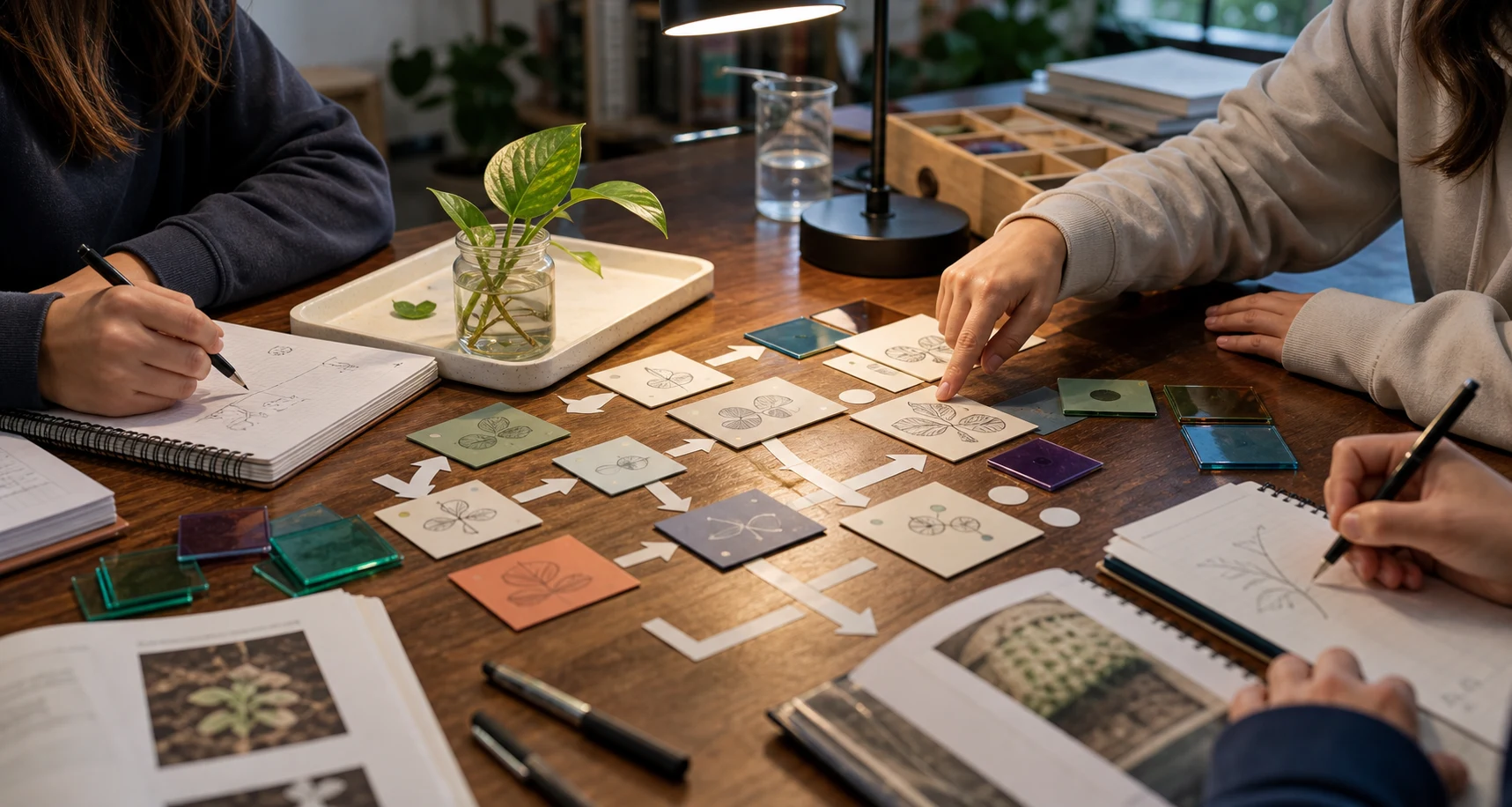
Build retrieval paths
Connect the idea to relationships, anchors, context, and use.
Do not mistake emotion for evidence
An anchor has to support explanation and transfer, not merely feel memorable.
Principle two
Experience before explanation.
Learners have more to work with when an idea is tied to something they heard, saw, touched, moved through, performed, debated, drew, built, or created.
In an Etuosity experience, the opening move is not a definition. It is an anchor that gives the formal concept a body, sound, scene, image, or social moment.

Start with an anchor
The concept enters through rhythm, movement, image, story, performance, or making.
Do not confuse activity with learning
The experience has to map back to the concept, symbol, or skill.
Principle three
Pattern before procedure.
Conceptual understanding depends on relationships: what changes, what stays the same, and how the parts fit together.
Etuosity uses rhythm, repetition, variation, composition, choreography, role-play, and visual structure to make the pattern legible before learners practice formal steps.
Principle four
Creation before regurgitation.
Learners reveal understanding when they can explain, build, draw, teach, remix, or apply an idea in a new context.
That learner output becomes the measurement layer: can they create with the idea, then connect the creation back to formal knowledge?
Create
Can the learner make a song, diagram, performance, model, game rule, comic, or explanation that carries the idea?
Transfer
Can the learner recognize the same structure beyond the first activity?
What Etuosity watches as it develops.
Learner explanation
How do learners explain an idea before and after the anchor-based experience?
Memory and transfer
Can learners retrieve the relationship and use it in a new task, case, or setting?
Pilot and adult learner feedback
Do educators, adult learners, reviewers, and pilot partners see what needs to change?
Next step
Bring rigor to the next phase.
Etuosity needs collaborators who can design pilots, inspect anchor quality, review learner output, and turn promising examples into stronger measured practice.
Help review the work